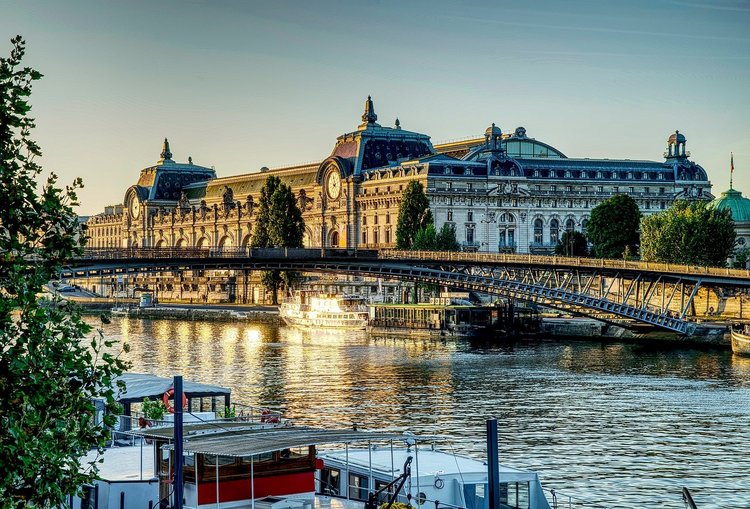
RER C
Use RER C for Musée d’Orsay station. It is the closest named rail stop and works well from places served by the RER.
- Musée d’Orsay station
- Directly by museum
- Rail option
Get to Orsay Museum by RER C, Métro line 12, bus, taxi or on foot. Check your entrance before leaving: timed tickets use the Quay Entrance, while other visitors may need the Forecourt Entrance. This guide covers access, luggage, step-free arrival and timing.
RER C is the simplest public transport choice because Musée d’Orsay is directly by the museum. Check the entrance printed in your booking before you set off.
Use RER C for Musée d’Orsay station. It is the closest named rail stop and works well from places served by the RER.
Use line 12 to Solférino if you are coming from a line 12 location. The museum is about a five-minute walk via rue de Bellechasse.
Several bus routes serve the museum area. This can suit travellers already on a direct route or visitors avoiding Metro stairs.
Ask to be dropped at quai Anatole-France if you need accessible taxi or specialist-vehicle drop-off. Keep the entrance name ready.
Walking works well from nearby Left Bank streets and the Seine. It is less useful when you have luggage or a fixed timed slot.
Visitors with luggage use Entrance 2 at the Forecourt during renovation. This also serves visitors without tickets and non-timed ticket holders.
Driving can get you close, but parking is separate from museum entry. Choose a public car park before leaving and allow for the walk.
Renovation changes which entrance different visitors should use. Read your latest ticket instructions before travelling.
Timed tickets for collections or temporary exhibitions use the Quay Entrance. Paris Museum Pass visitors need a timed ticket and also use this entrance.
The Forecourt Entrance is for priority visitors, non-timed tickets, visitors without tickets, luggage, reduced mobility, groups and museum activities.
During the works, general map directions can place you on the wrong side. Use the entrance named by your ticket and check current signage on the day.
Line 12 is the listed Metro connection. RER C is closer if it fits your starting point.
Use Solférino, then walk toward the museum via rue de Bellechasse. The route is about a five-minute walk.
Use the RATP journey planner for live routes and service notices. Check again on the day, especially during works or major events.
Choose a direct bus only when it matches your starting point. Check live diversions before leaving.
These routes are listed for the museum area. Check the live direction and nearest stop before boarding.
Use them when they give a direct route from your area. Traffic can make the Metro more predictable.
Confirm the current route, stop and diversion notices with the transport operator on the day.
These are route-planning patterns, not guaranteed timings. Use live transport information before leaving.
| Starting point | Simple route | Why it works | Final step |
|---|---|---|---|
| Anywhere on RER C | RER C to Musée d’Orsay | Directly by museum | Check Quay or Forecourt entry. |
| Line 12 corridor | Line 12 to Solférino | Listed Metro connection | Walk via rue de Bellechasse. |
| Nearby Left Bank | Walk or direct bus | Avoids an unnecessary transfer | Use ticket instructions at the block. |
| Central Paris with luggage | Taxi to quai Anatole-France | Useful for specialist drop-off | Use Forecourt Entry if applicable. |
Traffic lights, the large museum block, crowds and entrance changes can make a short map route feel longer.
This is the listed route from the Metro. It suits visitors travelling light and not rushing to a meeting point.
Musée d’Orsay station is directly by the museum. The remaining task is choosing the correct side of the building.
Getting near the museum is easier than parking. The final entrance approach still matters.
For accessible taxi or specialist-vehicle drop-off, use quai Anatole-France. Then follow the entrance instructions on your ticket.
Verify a public car park before leaving. Do not assume the museum provides visitor parking.
Traffic controls, bus lanes and loading rules can prevent a driver stopping exactly at a map pin.
The nearest station does not prove that every lift, exit and route is accessible on the day.
During renovation, disabled visitors may use the Forecourt Entrance with priority. Disabled visitors and one companion have free admission with valid proof.
Check lift status at your origin, any interchange and your destination before travelling.
Choose an exit that suits your route. Confirm current access conditions before travelling.
Wheelchairs, folding seats, canes and strollers are available in exchange for ID and cannot be reserved.
Bag checks can delay entry. Travel light and keep valuables with you.
Visitors may be asked to open bags, luggage or parcels at the entrance, exit or elsewhere in the museum.
Luggage larger than this is not allowed. Cabin-size suitcases within this limit must be stored.
Store coats and small luggage. Do not leave documents, cash, payment cards, valuables, cameras, laptops or phones there.
Save your ticket, the entrance instruction and any guided meeting-point message before leaving. Phone signal and inbox searches can slow you down at the queue.
A reserved time controls access. It does not remove security screening or the walk from the station.
Reaching a station is not reaching the entrance. Leave room for the exit, orientation, final walk and security checks.
A guided product may use a separate meeting point. Check your voucher for the exact location and whether admission is included.
Street names and entrance signs are more useful than a distant building view.
This is Entrance 1 for timed collection and exhibition tickets during renovation.
This is Entrance 2 for priority visitors, luggage, reduced mobility, groups and non-timed entry cases.
This station confirms you are directly by the museum. It does not identify your correct entrance.
This line 12 stop confirms the Metro approach. The walk to the museum uses rue de Bellechasse.
This is the listed taxi and specialist-vehicle drop-off and pick-up point for accessible arrivals.
A correct route only helps if it ends at the right entrance before your reserved time.
Use your latest ticket or operator message, not an old calendar note.
Keep Quay or Forecourt instructions with your ticket.
Look for service notices and diversions before setting off.
Security checks apply and bags larger than 56 × 45 × 25 cm are not allowed.
Screenshot the ticket and any meeting point before leaving your accommodation.
You may need it for the ticket, route planner and entrance instructions.
Use Musée d’Orsay, Esplanade Valéry Giscard d’Estaing, 75007 Paris, then match your ticket to Quay or Forecourt entry.
Use RER C to Musée d’Orsay where it fits. Otherwise use line 12 to Solférino or a direct listed bus.
Include the station exit, entrance orientation and security screening in your arrival plan.